When a Yoruba child is born, the family does not pick a name off a shelf. They look at the house first. Who died recently, who is owed, what the family is carrying, what the parents survived to get here. There is a proverb for it: Ilé ni à ń wò kí á tó sọ ọmọ lórúkọ. We study the home before we name the child.
Then there is the one everybody quotes: Orúkọ ọmọ ni ìjánu ọmọ.
It gets translated loosely as "a child's name is his destiny," which is soft. Ìjánu is a bridle. The strap you put in a horse's mouth to steer it. My people are not saying a name predicts where you end up. They are saying a name pulls you there.
I have been thinking about that strap for a while now, because the most consequential technology of my lifetime got named by a 28 year old assistant professor who was trying to dodge a turf war, and we have all been riding in the direction he pulled ever since.
The Room Where It Got Named
August 31, 1955. John McCarthy, then at Dartmouth, writes a funding proposal to the Rockefeller Foundation with Marvin Minsky, Nathaniel Rochester of IBM, and Claude Shannon of Bell Labs. Two month study, ten men, summer of 1956. The document is the first recorded use of the phrase "artificial intelligence."
Here is the part that should be taught in every intro course and almost never is. McCarthy said later, on the record, that one of his reasons for inventing the term was to escape association with cybernetics. Cybernetics was the incumbent label for this work, coined by Norbert Wiener at MIT from the Greek kubernētēs, the steersman. Wiener was a giant and a difficult man. McCarthy's own explanation is that he did not want to accept Wiener as a guru or argue with him.
Read that as a founder reads it, because that is what it is. The field got its name from a positioning exercise. McCarthy needed category separation from a better known competitor with a stronger brand, so he coined a term with enough distance in it that nobody would confuse the two. He has also admitted nobody on the team particularly liked the name. He had to call it something.
Seventy years of public imagination, trillions in capital allocation, every regulatory framework on earth, all downstream of a category name chosen to avoid a hard conversation with a colleague in Cambridge.
What "Artificial" Actually Ships
Words carry freight whether you loaded them or not.
Artificial flavoring. Artificial turf. Artificial sweetener. Artificial limb. Every consumer use of that word in English signals a substitute for the real thing, accepted because the real thing was unavailable or too expensive. The word tells you in advance that you are getting the lesser version.
Now bolt it onto intelligence, the one property humans use to justify our position at the top of the food chain, and watch what happens. You have built a phrase that says: here is a counterfeit of the thing that makes you you. Counterfeits get inspected for defects. Counterfeits get suspected of passing themselves off. The word primes you to hunt for the seam where the fake shows through, and it primes you to feel something when it stops showing.
The engineering did not create the "us against it" reflex. The label did that before anyone wrote a line of code.
There is a second problem, which is that the word is now simply inaccurate. A model that learns representations from data it was never explicitly handed is doing something. Whatever you call that, it is not synthetic in the way vanillin is synthetic. McCarthy's own colleagues wanted genuine intelligence, and they settled for a name that announced the opposite.
The Alternatives Existed and They Lost
This is what kills me. The better frames were already on the table and they got out-marketed.
Alan Turing, 1950, opens his Mind paper by asking whether machines can think and then throws the question out as too poorly defined to argue about. He replaces it with a test about behavior. He saw the semantic trap five years before the trap got its name.
J.C.R. Licklider publishes "Man-Computer Symbiosis" in 1960. The entire premise is coupling, a partnership where the human sets the goals and the machine handles the work that blocks the human from thinking.
Douglas Engelbart publishes "Augmenting Human Intellect" in 1962 and then demonstrates most of modern computing in 1968.
Symbiosis. Augmentation. Both frames existed early, both were coherent, and both lost the naming war to a phrase invented for a grant application. Licklider and Engelbart won the engineering argument and lost the language, and the language is what the public inherited.
The Fear Is Downstream of the Frame
Stephen Hawking tells the BBC in December 2014 that the development of full artificial intelligence could spell the end of the human race. Elon Musk, at MIT that October, calls it our biggest existential threat and reaches for the demon summoning line. March 2023, thousands of signatures on an open letter asking labs to pause training. May 2023, a one sentence statement putting extinction risk from AI alongside pandemics and nuclear war. November 2023, twenty eight countries sign the Bletchley Declaration.
I want to be careful, because I am not calling those people stupid and I am not calling the risk fake. I build systems that make consequential calls about physical assets carrying human beings. I take failure modes seriously for a living.
My argument is narrower. The vocabulary was pre-loaded. When the public conversation finally arrived, the only available frame was a counterfeit mind with its own agenda, and every serious technical concern had to be expressed in that vocabulary to be heard at all. A researcher worried about distribution shift in a deployed classifier gets translated into a headline about the machines waking up, because the category name told the headline writer what kind of story this was in 1955.
Before Anyone Says It
The objection is coming, so let me put it on the table. A rename is cosmetic. The capabilities are what they are. Calling it something friendlier is PR, and PR is what you do when you cannot fix the product.
I would take that seriously if the historical record supported it. It does not.
The clinical technique we now call MRI was called nuclear magnetic resonance imaging, because the physics involves atomic nuclei. Hospitals dropped the word "nuclear" as the technology moved toward patients, because patients heard that word and thought about radiation they were not receiving. The switch was largely complete by the mid 1980s. Same machine, same physics, different adoption curve. The name was load-bearing.
Frank Luntz wrote a memo in 2002 advising Republican campaigns to say "climate change" instead of "global warming" on the explicit grounds that it sounded less frightening and more controllable. That memo leaked and became infamous precisely because everyone understood the tactic works.
Cybernetics itself came from the word for steersman, which is why Wiener's frame produced decades of control theory and why McCarthy's frame produced decades of arguments about machine consciousness. The metaphor inside the name sets the research questions.
A label works like a bridle. It does not determine the destination, and it steers hard.
Another Intelligence
Here is what I would put on the stele.
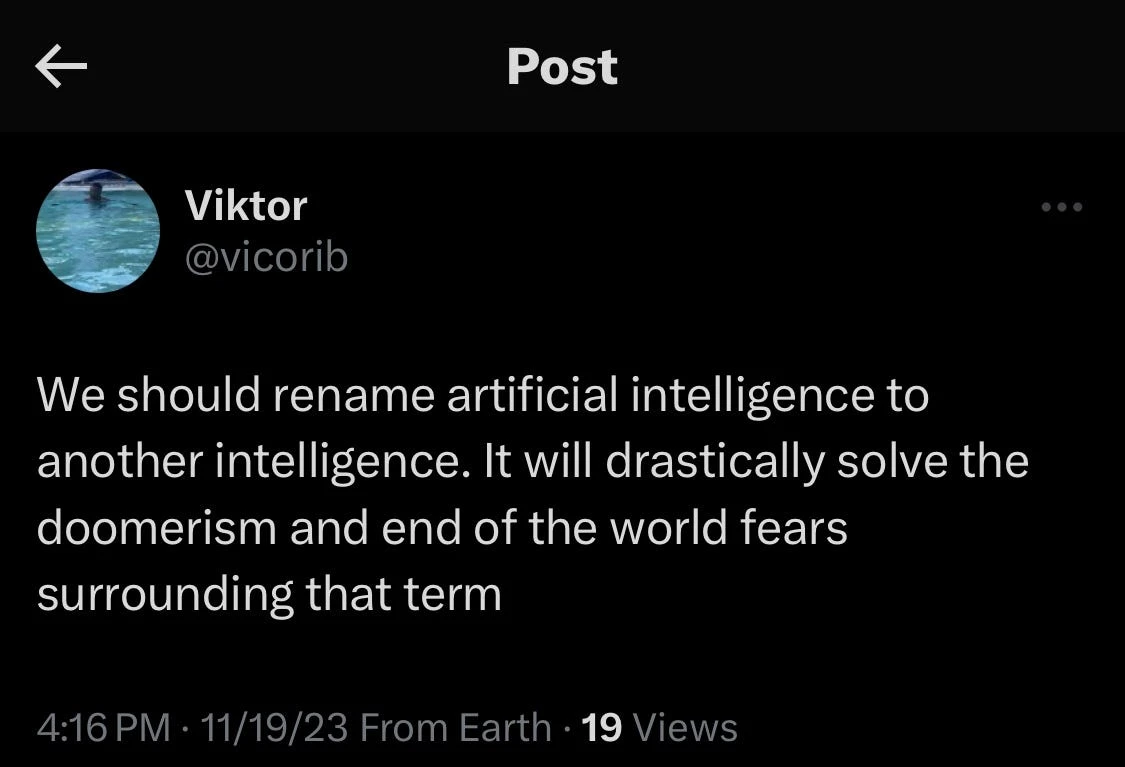
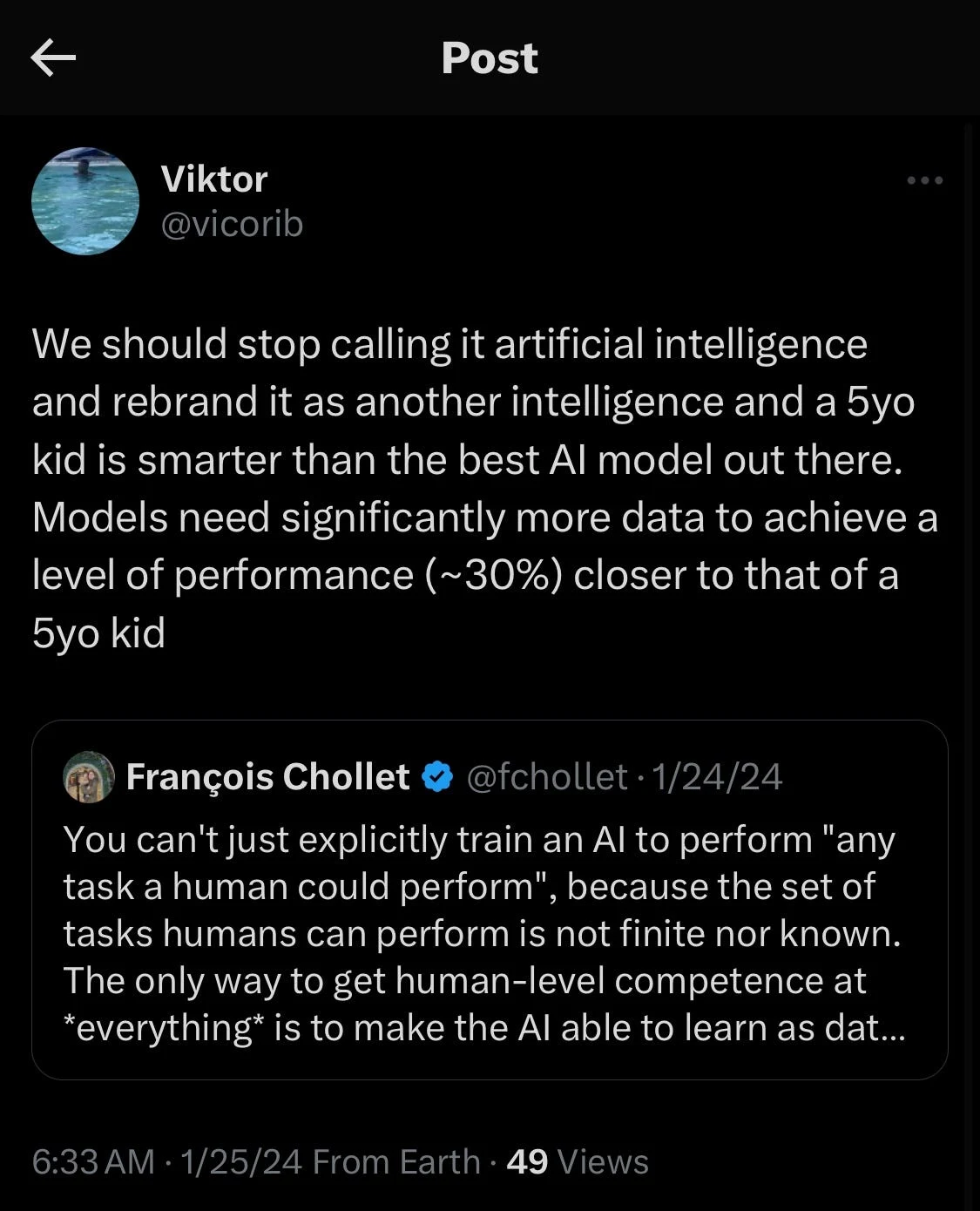
Another Intelligence. Same initials, so nobody has to redo their slide decks, their domain names, or their ticker symbols. Entirely different freight.
"Another" does two things that "artificial" cannot do. It grants the thing category membership without claiming it is a copy of us, and it drops the hierarchy. Octopus cognition is another intelligence. It solves problems, it manipulates its environment, it is genuinely alien in architecture, and nobody loses sleep over whether it is a counterfeit human. Corvids, cephalopods, and elephants all run cognitive processes we did not design and do not fully model, and the existence of those processes threatens nobody's dignity.
Machine cognition is stranger than any of those, and it is ours, and it is still another kind. A system that has read more text than any human who ever lived and cannot reliably count letters in a word is a different animal, and it deserves a name that says so.
Push the frame one step further. Instead of artificial general intelligence, another general intelligence. The acronym survives. The implied endgame changes completely: from a race to build a replacement human, to the arrival of a second kind of general capability that we work alongside.
That is closer to what is actually happening, and it is closer to what the engineering literature has described since Licklider.
Where I Am Implicated
I should say the uncomfortable part, since I write "AI" on my own materials constantly.
The company I run builds models that predict when parts on an aircraft are going to fail before they fail. When I write a deck for an airline or an agency, the phrase "artificial intelligence" goes in it, near the top, in a large font. I do that because procurement teams have budget lines with those words on them, because search behavior rewards those words, and because a buyer who cannot pattern match your category will not take the meeting.
So I pay the tax on a word I think is wrong. Every founder in this space does. That is how a naming decision made in 1955 keeps enforcing itself in 2024: the incentive to use the incumbent label is immediate and personal, and the cost of the label is diffuse and collective.
What I control is the language inside the building. In how we describe what the system does to the engineer who has to act on its output, there is no artificial anything. There is a model with a confidence level, a human with authority, and a decision that belongs to the human. The maintenance chief keeps his authority and gains another read on his own aircraft, from something that processes sensor history at a scale his eyes cannot.
That is another intelligence doing its job. It took me a while to notice that the honest internal description and the marketable external description were two different sentences.
The Close
McCarthy needed a name that would not put him in a room arguing with Norbert Wiener. He got one. It worked so well it outlived him, outlived the workshop, outlived the entire research program it was written to fund, and it is now the strap in the mouth of the most consequential technology anyone alive will touch.
We are allowed to change it. Fields rename themselves when the name stops describing the work. The hospital did it with the scanner. The physicists did it when quantum mechanics outgrew the word "atom." Nothing sacred was violated.
Worry is fine. Worry about real failure modes rather than about a connotation that came free with a grant application.
My grandmother's people knew this before anyone built a computer. You study the house before you name the child, because the name is the strap, and the strap decides which way the head turns.
We named this one in a hurry, to win an argument that nobody remembers.
We can do better than that.
V