"You want to know how I did it? I never saved anything for the swim back."
-- Vincent Freeman, Gattaca (1997)
There is a woman in Genesis who does one thing wrong. One thing. She is fleeing a city that God has decided to destroy. She has been told, explicitly, by angels, not to look back. Her husband is ahead of her. Her daughters are beside her. Safety is in front of her. The fire is behind her. And she turns around.
Genesis 19:26: "But Lot's wife looked back, and she became a pillar of salt."
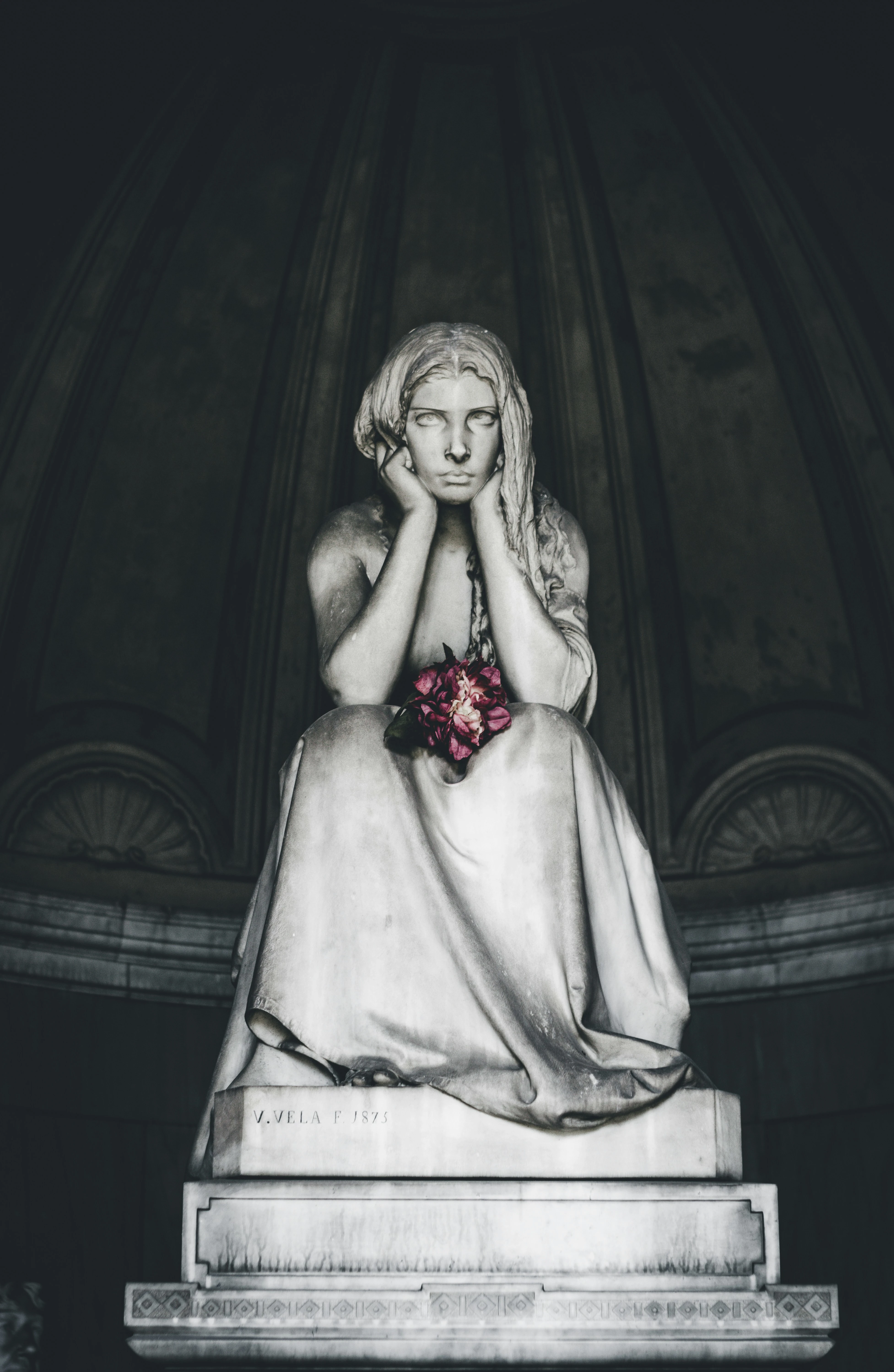
One glance. That is all it took. Not a full stop, not a return journey, not a prolonged meditation on what she was leaving. A glance. A single moment of orientation toward what was behind her instead of what was ahead. And she was turned into something frozen, crystallized, lifeless. A monument to the cost of looking backward.
I have thought about this story more in the last couple of years of building than in all my years of catechism combined. Because I have come to believe that the thing that killed Lot's wife is the same thing that is killing most people slowly, invisibly, every single day. Not fire. Not divine punishment. The pull of the past. The seduction of what was. The quiet, reasonable, comforting impulse to orient yourself toward what is behind you instead of what is in front of you.
That impulse has three forms. In the mind, we call it nostalgia. In the body, we call it aging. At the end, we call it death. And I am going to argue that all three are expressions of the same force, that all three operate by the same mechanism, and that all three should be refused with everything we have.
Part I: The Mind That Looks Back
Nostalgia is the most socially acceptable form of surrender.
We treat it as warm. We treat it as human. We build entire industries around it: reunion tours, throwback playlists, vintage fashion, reboots of movies that were fine the first time. We scroll through old photos with a bittersweet ache and call it healthy reflection. We say things like "those were the days" and "they don't make them like they used to" and nobody pushes back because it feels harmless. It feels good, even.
But strip away the sentiment and look at what nostalgia does. It is the mind deciding that the best version of reality has already happened. It is a cognitive orientation toward the past that necessarily diminishes the present and forecloses the future. When you are nostalgic, you are not remembering. You are comparing. And the present always loses that comparison, because the past has been edited by memory into something it never was. The difficult parts have been sanded down. The boring parts have been cut. What remains is a highlight reel that no present moment could ever compete with, because present moments include uncertainty, discomfort, and the grinding reality of being unfinished.
This is why nostalgia is poison for builders. Building requires a fundamental belief that the best version of what you are creating has not happened yet. It requires you to sit in the discomfort of an incomplete present and keep working toward a future you cannot see clearly. The nostalgic mind cannot do this. It is too busy curating the past to invest in the future. It saves something for the swim back.
In Yoruba cosmology, there is the concept of Ori, which translates roughly as "inner head" or personal destiny. Before birth, each person's Ori kneels before Olodumare, the supreme creator, and chooses a destiny. That destiny is forward-facing. It is a trajectory, not a position. Your Ori did not choose for you to arrive somewhere and stop. It chose a direction of becoming. To be consumed by what was, to let the mind calcify around a former version of yourself, is to dishonor the Ori's choice. It is to say: the destiny you selected for me is less interesting than the past I have already lived. It is a betrayal of the self you chose to become.
Philippians 3:13-14, Paul says it with his usual bluntness: "Brothers and sisters, I do not consider myself yet to have taken hold of it. But one thing I do: Forgetting what is behind and straining toward what is ahead, I press on toward the goal." Paul does not say he fondly recalls what is behind and occasionally glances forward. He says he forgets it. Deliberately. Actively. He treats the past as something to be released, not cherished. And he uses the word "straining," which implies that forward motion requires effort, that the default pull is backward, and that pressing on is an act of will against a gravitational force that wants to drag you back.
That gravitational force is nostalgia. And it is not harmless.
I watch it in the startup world constantly. Founders who keep referencing their previous company like it was the peak. Engineers who talk about "the good old days" at a former employer. Investors who compare every new opportunity to the one deal that made their career a decade ago. They are all doing the same thing Lot's wife did. They are fleeing forward while looking backward. And the result is the same: they become salt. Crystallized. Preserved. Frozen in a form that cannot grow, cannot adapt, cannot become anything new.
In Gattaca, Anton is the nostalgic one, even though the film never uses that word. He is the brother who was supposed to win. Genetically engineered, biologically optimized, designed from conception to be superior. His entire identity is built on what he already is. Vincent, the "invalid," has no past worth being nostalgic about. His past is a catalogue of rejection, limitation, and being told he is not enough. So he has nothing to look back at. Nothing to save anything for. His only option is forward, and that total commitment to forward motion is what lets him beat the brother who has every advantage except the willingness to burn all his reserves on the swim out.
"I never saved anything for the swim back." Listen to what Vincent is telling you. He is telling you where his mind was pointed. One direction. The whole time. Forward, only forward, with nothing held in reserve. Anton's mind is split between two directions, and that split is the difference between someone who makes it and someone who drowns.
Part II: The Body That Decays
If nostalgia is the mind looking backward, aging is the body doing the same thing.
Think about what aging actually is at the cellular level. Your DNA accumulates damage and stops repairing itself properly. Your telomeres, the protective caps on your chromosomes, shorten with every division until your cells can no longer replicate. Your mitochondria lose efficiency, producing less energy and more oxidative waste. Senescent cells accumulate in your tissues, secreting inflammatory signals that degrade the structures around them. Your stem cells exhaust themselves and stop regenerating the tissues that depend on them.
Every one of these processes is a form of reversion. The body is retreating toward the inorganic matter it was assembled from. Your cells are forgetting how to be cells. Your tissues are forgetting how to be tissues. Your organs are forgetting how to be organs. Aging is biological nostalgia: the body gradually returning to a simpler, less organized, less alive version of itself. Dust to dust. People think that phrase is poetry. It is a description of a process. And we have decided, for reasons that are entirely cultural and not at all scientific, that this process is natural, beautiful, and should be accepted with grace.
"Aging gracefully" is the biological equivalent of "those were the days." It is a phrase that makes surrender sound elegant. It reframes decline as dignity. It takes a process that robs people of their independence, their cognition, their mobility, their continence, their ability to recognize their own children, and wraps it in language that makes resistance seem undignified.
I watched the 2024 presidential debate between Biden and Trump. Two men, 81 and 78, competing for the most demanding job on earth while visibly struggling with the consequences of biological decline. I thought about my paternal grandmother, approaching 90, experiencing the same erosion of capability that every human body undergoes if it lasts long enough. And I thought: why do we accept this? We do not accept it when a bridge deteriorates. We do not accept it when software degrades. We do not accept it when any system we have built fails to maintain itself. We repair it, reinforce it, rebuild it. Only with the human body do we call deterioration natural and resistance hubris.
The science of longevity is real, active, funded, and producing results. Senolytics, drugs that selectively eliminate senescent cells, have shown the ability to reverse age-related conditions in preclinical studies. Telomerase activation has extended lifespan in model organisms. Mitochondrial rejuvenation therapies are being developed to restore cellular energy production. Regenerative medicine, including stem cell therapies and gene editing with CRISPR/Cas9, is advancing toward the ability to repair and replace damaged tissues.
These are engineering problems. Complex ones, yes. But engineering problems. And the only reason we do not treat them with the urgency they deserve is that we have internalized the idea that the body's backward trajectory is sacred. That aging is a feature. That death is a design choice.
Wrong. And our own theology proves it.
Part III: The Final Bug
In the beginning, there was no death.
I mean this literally, as a theological claim at the foundation of Christian doctrine. Genesis describes a world in which humans were designed to live in an unbroken relationship with God, in bodies that did not decay, in a garden where the Tree of Life was freely accessible. Death entered the world through the Fall. Romans 5:12: "Therefore, just as sin entered the world through one man, and death through sin, and in this way death came to all people, because all sinned." Death, in the Catholic framework, was never part of the original design. It is a corruption. An intrusion. Something that was never supposed to be here.
Islam sees this differently, and I want to be honest about that. In the Quran, death was created with purpose. Surah Al-Mulk (67:2): "He who created death and life to test you as to which of you is best in deed." Death is a deliberate act of divine design, a test, not a consequence of inherited sin.
Every soul will taste death is a decree in Islam, not a diagnosis. I respect that framework. But I am writing from within the Catholic tradition, and within that tradition, death entered through corruption and is destined to be destroyed. That is the ground I stand on.
If you take that seriously, and I do, then death is a bug introduced by the Fall. The body was corrupted into decaying. It was not built for that. And working to eliminate death? That is restoration. That is debugging. That is the attempt to return the system to its original specifications. Everyone wants to make this the Icarus story, where humanity flies too close to the sun and gets burned for its arrogance. But Icarus was trying to escape a prison. So are we.
Revelation 21:4 describes the end state God intends: "He will wipe every tear from their eyes. There will be no more death or mourning or crying or pain, for the old order of things has passed away." The old order. Death belongs to the old order. A phase in a corrupted system, destined to be eliminated. If God's own plan for the future includes the abolition of death, then human efforts to extend life and reverse aging move in the same direction Scripture points. They are early, imperfect, incomplete attempts to reach the reality that has already been promised.
1 Corinthians 15:26: "The last enemy to be destroyed is death." Paul calls it an enemy. Not a friend. Not a natural part of the cycle. Not something to be accepted with grace and dignity. An enemy. The last one. The one that persists after every other form of corruption has been addressed. And it will be destroyed. That is a promise, not a suggestion.
Now, I am not confusing a senolytics trial with the Second Coming. Biomedical research will not fulfill biblical prophecy. But the instinct to fight death, to refuse its inevitability, to treat it as a problem to be solved rather than a mystery to be accepted, that instinct is more theologically coherent than the alternative. The person who says "death is natural, accept it" is actually making the more radical theological claim. They are saying that the post-Fall state is the true state. That the broken version of reality is the real one. That the bug is actually a feature.
I reject that completely.
And here is where Gattaca becomes essential again. The entire premise of that film is a society that has accepted biological destiny as absolute. Your genes determine your lifespan, your health, your capability, your social position. The system is designed to enforce the body's programming. Vincent's rebellion goes deeper than fighting the society. He fights the premise itself. He refuses the idea that what his body was programmed to do determines what he can become. He does not accept the read-out. He does not accept the expiration date. He does not save anything for the swim back because he does not believe the swim back is where he belongs.
That is the posture I am arguing for. Toward genetic determinism. Toward aging. Toward death. Toward every form of biological decline that we have been taught to accept as inevitable. The body says: you are winding down. The body says: your best years are behind you. The body says: save something for the swim back, because the swim back is all that is left. And the correct response, the theologically coherent response, the response that honors both science and Scripture, is Vincent's response:
No. I never saved anything for the swim back.
Part IV: The Three Refusals
So here is where the three threads converge.
Nostalgia is the mind saving something for the swim back. It keeps one eye on the past, one foot in a former version of reality, always maintaining the option to retreat into what was. It diminishes the present by comparing it to an edited version of the past. It makes you salt.
Aging is the body saving something for the swim back. Every process of cellular decline is the body reverting, returning, retreating toward the inorganic simplicity it emerged from. It is the biological system gradually giving up on its own complexity. It makes you dust.
Death is the swim back. It is the final completion of the backward trajectory. The mind stops. The body stops. Everything that was organized, complex, alive, and forward-moving comes to rest. The past wins. The pull toward what was finally overcomes the push toward what could be.
And all three come wrapped in the same packaging. Nostalgia is healthy. Aging is graceful. Death is inevitable. The same lie told three ways: that the backward direction is the true one, that the past has more authority than the future, that you should make peace with decline because decline is what is real.
Lot's wife believed that. She looked back at Sodom not because she loved its wickedness but because it was familiar. It was what she knew. The fire ahead was unknown. The destruction behind was at least comprehensible. And so she turned, and she froze, and she became a monument to the human preference for a known past over an unknown future.
I refuse all three!
I refuse nostalgia because my Ori chose a destiny that is forward-facing, and every moment I spend curating the past is a moment stolen from the future I am supposed to be building. Kquika does not exist yet in the form it needs to take. The work is unfinished. The vision is incomplete. Looking back at what was comfortable, what was familiar, what was easier, is a betrayal of the work that is in front of me.
I refuse aging because the body's decline has nothing sacred about it. The nine hallmarks of aging, genomic instability, telomere attrition, epigenetic alterations, loss of proteostasis, deregulated nutrient sensing, mitochondrial dysfunction, cellular senescence, stem cell exhaustion, and altered intercellular communication, are engineering failures that we are increasingly capable of understanding and addressing. Complex problems, but problems. And problems are what builders solve.
I refuse death because it is a bug, not a feature. Because Scripture itself calls it an enemy to be destroyed. Because the original design did not include it. Because every human instinct to fight for survival, to rage against the dying of the light, to refuse the final swim back, is an instinct that is aligned with how we were meant to be, not opposed to it.
Conclusion: Do Not Look Back
There is a reason the angel told Lot and his family not to look back. The command existed because the act of looking back would change what they were. It would reorient them. It would pull them out of the trajectory of survival and into the gravitational field of what was already being destroyed.
Nostalgia does it to the mind. Aging does it to the body. Death does it to the whole person. Same force, same direction, same gravitational pull back toward what you came from.
Vincent Freeman was the inferior brother. Unengineered. Unoptimized. Given an expiration date at birth. But he had one thing that no amount of genetic engineering could replicate: he was constitutionally incapable of looking backward. His mind faced one direction. His body followed. And he made it to the stars.
The Yoruba say: Ori lo da mi, A da mi si re. "It is my Ori that created me, and created me well." Your Ori chose forward. Your Ori chose becoming. Your Ori did not choose for you to freeze, to crystallize, to become salt, to save anything for the swim back.
So do not look back. Not with your mind. Not with your body. Not with your life.
The past is fire. The past is Sodom. The past is the ocean behind you, and you are already swimming.
Do not save anything for the swim back.