I wrote this as an email rebuttal to Nature’s editor, Madgalena and the Main author of their recent article, Jason advocating for degrowth, while well-intentioned, ultimately presents a flawed and dangerous vision for the future. Its reliance on untested assumptions and a rejection of the very engine of human progress — economic growth — risks plunging us into a quagmire of stagnation and decline. Napoleon Bonaparte’s words, “We are made weak both by idleness and distrust of ourselves,” serve as a stark reminder of the perils of abandoning ambition and embracing stagnation.
Firstly, the article paints an inaccurate picture of the current economic landscape. It falsely claims that high-income economies are solely responsible for environmental degradation (check graph attached), conveniently ignoring the rapid industrialization and pollution emanating from developing nations. To suggest that degrowth is the only path to sustainability is not only disingenuous but also ignores the tremendous strides made in clean technologies and resource efficiency. Renewable energy sources are becoming increasingly cost-competitive, and advancements in areas like circular economy and green chemistry offer promising solutions for decoupling economic growth from environmental impact.

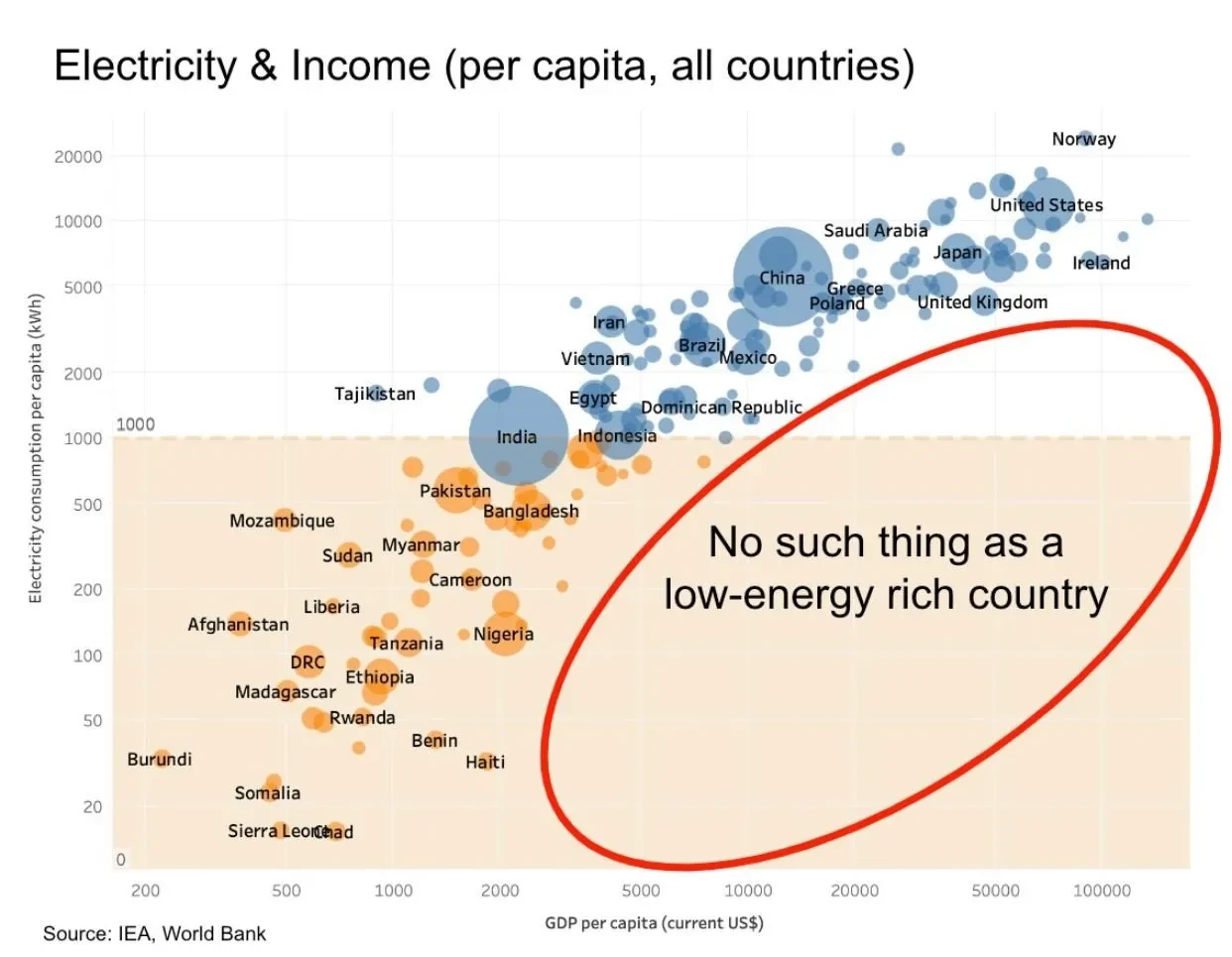
Secondly, the article’s call for abandoning growth as a goal ignores its critical role in poverty reduction and human development. Throughout history, economic growth has lifted billions out of poverty, improved living standards, and fueled advancements in healthcare, education, and technology (check graph attached). Degrowth, with its inherent anti-prosperity stance, risks jeopardizing these hard-won gains and condemning developing nations to perpetual underdevelopment. As Napoleon aptly stated, “If he is a mere individual, he becomes nothing,” perfectly capturing the debilitating effect of stagnant economies on individuals and societies. Capitalism is the fastest way of pulling millions out of poverty.

Thirdly, the article’s proposed solutions, such as reducing working hours and scaling down entire industries, are fraught with practical challenges and unintended consequences. Lowering productivity through reduced work hours might feel appealing in the short term, but it comes at the cost of reduced output, potentially leading to shortages and inflation. Similarly, arbitrarily scaling down entire industries, especially those deemed “less necessary” by a select few, risks displacing millions of workers and disrupting vital supply chains. Such drastic measures, implemented without careful consideration, can destabilize economies, and exacerbate existing inequalities.
Instead of succumbing to the degrowth delusion, we should focus on harnessing the power of innovation and responsible growth to create a more sustainable and equitable future. By investing in clean technologies, promoting responsible consumption, and fostering international cooperation, we can achieve environmental goals without sacrificing economic progress. We must not succumb to the “distrust of ourselves” that Napoleon warned against, but instead, channel our collective ingenuity and entrepreneurial spirit to build a future where prosperity and sustainability go hand in hand.
Remember, Napoleon’s words hold true for both individuals and nations. Just as an idle individual stagnates, so too will a nation that abandons the pursuit of progress. Let us reject the siren song of degrowth and embrace the power of responsible growth to build a brighter future for all.
Happy Holidays, everyone!