I was raised Catholic. Still Catholic. Will remain so forever. I have written that sentence on this blog before and I am writing it again because what follows is going to read, to some, like an attack. It is not. It is a founder looking at a system he grew up inside, recognizing the playbook, and naming it.
The playbook is fear.
Not fear as feeling. Fear as infrastructure. Fear packaged, distributed, renewed monthly, with a clear value proposition and a forgiveness loophole written into the terms of service. Marketers run on it. Founders like me run on it. Religious institutions invented the playbook three thousand years before either of us showed up.
Two arguments, stacked. Morality did not come from religion. And what religion actually contributed was not the content of the rules but the enforcement mechanism. Fear of eternal consequence, on a recurring billing cycle.
Once you see it, you cannot unsee it.
The Borrowed Tablets
Thou shalt not covet thy neighbor's house, his wife, his manservant, his maidservant, his ox, nor his ass, nor anything that is thy neighbor's. Exodus 20:17. Sinai, tablets, Moses.
The standard reading is that this commandment introduced contentment to the world, that before the tablets came down humans were eyeing each other's livestock with no internal compass. That reading does not survive five minutes of historical contact.
The Code of Hammurabi was carved into basalt in Babylon around 1750 BCE, roughly three centuries before the most generous dating of the Mosaic law. Two hundred and eighty-two laws covering theft, property, false witness, family obligation, and the seizure of what belongs to another. The goring ox provisions in laws 250 through 252 read like the rough draft of Exodus 21:28-32. Same scenario, same framework, same penalties.
The stele surfaced in 1901. Friedrich Delitzsch argued for direct influence on the Hebrew Bible in his 1902 Babel und Bibel lectures and got run out of polite German theological society for it. The argument never went away. In 2010, excavators at Hazor in northern Israel pulled two Middle Bronze Age fragments of a cuneiform law collection out of the ground, the same genre as Hammurabi, sitting in Canaan centuries before Sinai.
Here the religious reader objects. Maybe both codes drew from the same divine source. Maybe Hammurabi got his from Shamash and Moses received the corrected edition.
Maybe. The simpler explanation, the one that does not require inventing revelation in cultures that never claimed it, is that contentment laws are a near universal feature of human societies. Every society that survives long enough to write things down works out that unregulated envy tears the village apart. The Mesopotamians knew it. The Egyptians knew it. The Yoruba knew it. The Han knew it. Nobody needed a burning bush to conclude that wanting your neighbor's wife makes a poor foundation for civic life.
Religion did not invent the prohibition against coveting. It inherited it, wrote it onto a tablet, attributed the tablet to a deity, and added a consequence stack that culture alone could not enforce.
That last move is the entire trick, and it is where the business model begins.
The Enforcement Upgrade
Cultural norms have a scale problem. In a village of two hundred, coveting your neighbor's ox costs you immediately. People know, people talk, your standing erodes. In a city of fifty thousand, you can steal and walk three blocks into a neighborhood where nobody knows your face. The reputational economy collapses under urbanization, and by the time you have empires the enforcement gap is a chasm.
Religion moved the enforcer from the village to the sky. Instead of neighbors watching, an omniscient deity watching. Instead of shame at the well, eternal fire. Horizontal accountability is fragile and bounded by geography. Vertical accountability is infinite and unfalsifiable.
In business terms, a platform play. Religion did not write the rules. It built the distribution layer for the rules, and the distribution layer ran on fear.
You can watch the layer get installed. The early books deliver consequences in this life, to bodies, in geography. Sodom. The flood. Lot's wife turning to salt for looking back. By Revelation the consequences have migrated almost entirely to the afterlife: hell, damnation, the lake of fire, the second death. The threats got bigger and harder to verify, which is exactly what you want from an enforcement mechanism. A consequence you cannot test is a consequence you cannot disprove.
Mark 9:43 is explicit. If thy hand offend thee, cut it off. It is better for thee to enter into life maimed, than having two hands to go into hell, into the fire that never shall be quenched. Matthew 25:46 closes with everlasting punishment. The threat is not a side note. The threat is the architecture.
The Forgiveness Loophole
Here the system reveals its second genius and its first structural weakness, which is the part Ezra wrote about on Threads and the part that has been bothering me for years.
Pure fear does not work, because pure fear is brittle. If the only message is comply or burn, then the moment someone decides they are already going to burn, the system loses its grip entirely. The threat overcommits and the audience checks out.
So the system added a release valve. Confession. Repentance. Absolution. Indulgence.
Catholicism, the tradition I know from the inside, built the valve into the sacraments. You sin, you confess, you say the prayers, you receive absolution, you continue. The forgiveness is real and the cost is bounded. By the medieval period the bounding had been quantified. In 1343, Clement VI issued Unigenitus Dei Filius, establishing the treasury of merit: Christ, Mary, and the saints had accumulated a surplus of spiritual merit, and the church, as steward, could distribute portions of it as indulgences. That is an actual papal bull, not Protestant slander, and the doctrine still stands in modified form.
By 1517 the system had been productized to the point of parody. Leo X needed money to finish St. Peter's. He authorized a plenary indulgence and sent salesmen across Europe. The most effective was a Dominican friar named Johann Tetzel, whose jingle outlived the Reformation. As soon as the coin in the coffer rings, a soul from purgatory springs.
A sales pitch. With a rhyme. For a financial product whose deliverable is reduced supernatural suffering for a dead relative.
Apologists correctly note that Tetzel overstated the doctrine, that official teaching required contrition, that the abuse was not the rule. All true, and none of it touches the point. By 1517 there was a market for forgiveness sophisticated enough to fund one of the largest buildings on earth. Half the proceeds went to the basilica. The other half went to the Archbishop of Mainz to service loans from the Fugger banking family, taken out to purchase his archbishopric.
A banking family. A construction project. A sales force with quotas. A jingle. The infrastructure of fear had become indistinguishable from the infrastructure of any other commercial enterprise.
That is what Luther saw in 1517. Not a religion that had failed, but one that had succeeded so completely as a business it could no longer tell the difference. His parishioners were coming back from Tetzel's stops saying they no longer needed to repent, because they had paid.
The product had eaten the gospel.
Ezra's point was that anchoring morality to fear of damnation creates a structural weakness, because the same framework that threatens you also forgives you on demand, which lets a person be a shitty individual all week and settle accounts on Sunday. He is right, and the historical record is the proof. The loophole is not a bug introduced by lazy modern Catholics. It was load-bearing from the beginning, because without it the fear architecture collapses under its own weight.
Vatican I and the Doubling Down
Skip forward three hundred and fifty years. The Enlightenment has happened. Rationalism and materialism have eroded the unfalsifiable claims the whole structure depended on. The Papal States are being annexed by the new Kingdom of Italy. Napoleon III's army, which had been protecting Rome, is about to be crushed at Sedan.
Pius IX convenes the First Vatican Council in December 1869 to defend the church against modern errors. The product of that council is Pastor Aeternus, which formally defines papal infallibility. When the pope speaks ex cathedra on faith and morals, he cannot err. Approved July 18, 1870. Two months later Italian troops breach the walls of Rome and the council is suspended.
Read that sequence as a businessman. The product is losing share to competitors that do not require a fear-based subscription. The CEO calls an all hands. The all hands ratifies, by formal vote, that the CEO cannot be wrong. That is not a theological development. That is a defensive consolidation of authority at the exact moment authority is most threatened.
Bismarck understood immediately. He read Vatican I as the church arming itself for international political leverage and launched the Kulturkampf in response. Infallibility was a corporate restructuring.
Vatican II and the Pivot
A century later, the same problem arrived from the opposite direction. The threat was no longer intellectual rivals. It was irrelevance. The Latin Mass, the unchanged liturgy, the whole product had aged out of the market. Catholics were leaving. The postwar generation had no patience for incomprehensible Latin and hellfire.
In 1959, John XXIII announced the Second Vatican Council with one Italian word: aggiornamento. Updating.
Vatican II, from 1962 to 1965, did almost everything Vatican I had refused to do. Vernacular Mass. Religious liberty. Ecumenical dialogue with Protestants and Jews. Lay participation. Sacrosanctum Concilium pushed for actuosa participatio, active participation, instead of a silent congregation kneeling through a ritual it could not parse.
Again, read it as a businessman. Market share is going to competitors offering accessibility and participation. The new CEO calls a four year offsite. The offsite produces sixteen documents repositioning the brand around community and modernity while preserving the underlying model.
What did it not do? It did not abolish hell. It did not retire infallibility, which was less than a century old at that point. It did not eliminate confession. The fear architecture was preserved. The packaging changed. The pews got more comfortable, the priest faced the people, the hymns were in English, and the threat of eternal consequence stayed on the books, because removing it would have collapsed the enforcement layer.
What Founders Do
Now the part where I have to be honest about my own profession.
Founders run on fear. Not as gleefully as religious institutions at their imperial peak, but the structural similarity is too tight to dismiss. Every onboarding flow you have seen this year was designed by someone who knows loss aversion is the strongest lever in the funnel. Fear of missing out. Fear of being left behind. Fear of the competitor adopting the tool first. Fear of obsolescence.
The deck I am building right now to raise for Kquika contains, if I am honest, at least three slides whose emotional payload is fear. The aviation industry will be disrupted. Your fleet will be uncompetitive. Your competitors are already moving.
I am not embarrassed about this and I am not writing from outside the system. I am writing from inside it, which is the only honest place to write from. Fear works. It has worked for three thousand years. It is not an aberration of late capitalism or a byproduct of engagement loops. It is the oldest enforcement technology we have, and we did not invent it. We rediscovered it.
Insurance runs on it. Cybersecurity runs on it. Pharmaceutical advertising in America runs on it so transparently it is almost charming. Ask your doctor about a condition you did not know you had. The political fundraising email you got this morning runs on it. The growth hacker manual is the indulgence sermon translated into JavaScript.
The point is not condemnation. It is lineage. When a SaaS marketer writes a subject line that says your account is at risk, they are deploying a tool whose engineering history runs through Leo X, through Augustine, through the prophetic books, through Hammurabi, and back into unrecorded village squares where the first contentment laws were enforced by the simple fact that someone might see you take what was not yours.
What Religion Actually Sold
If morality predates religion, and religion's contribution was enforcement rather than rules, what was actually being sold?
Relief. Not from sin in the abstract, but from the specific anxiety the system itself created. The threat was real to the people who held it, and the sacraments were the recurring purchase that kept it at bay. Pay your spiritual dues, take communion weekly, confess monthly, do your Easter duty, and the consequence stack stays suspended.
Same structure as a security company. They sell you the alarm and the monitoring service that keeps the alarm meaningful. The alarm alone is a noise maker. The monitoring alone is a phone bank. Together they are a complete product. Religion built the alarm in the prophetic books, built the monitoring in the priesthood and the sacraments, and ran the integrated offering for two thousand years before any founder thought to call it a service.
I am not saying religion reduces to this. I have been to enough Masses, in enough states of personal collapse, to know something else is happening in those buildings that does not fit on a balance sheet. But the business layer is real. Pretending otherwise is what let Tetzel fund a basilica with a jingle, what let Vatican I upgrade the CEO's authority during a market crisis, and what lets me deploy the same emotional architecture in a pitch deck without noticing what I am borrowing.
The Close
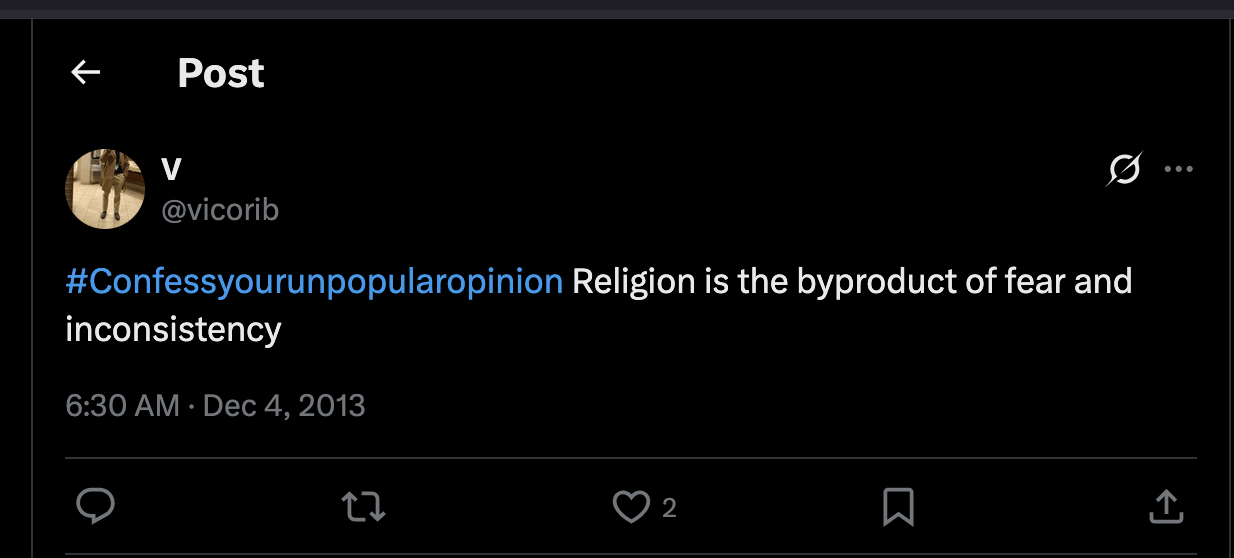
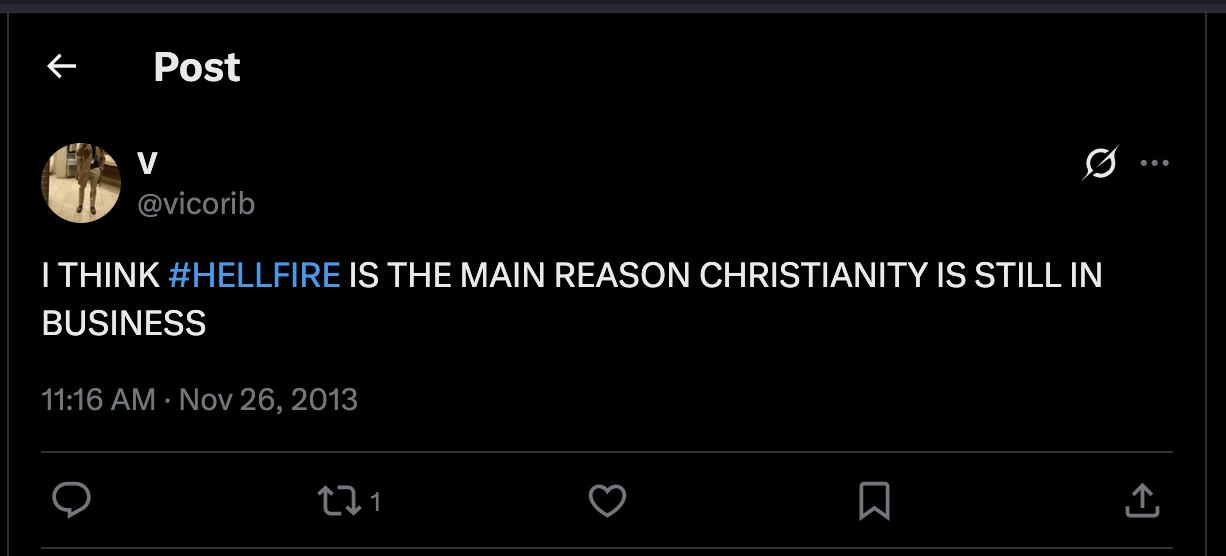
I have been making this argument, that culture wrote the rules and religion bolted on the enforcement, on the internet since 2013. Long before it was an essay it was a series of posts nobody asked for.
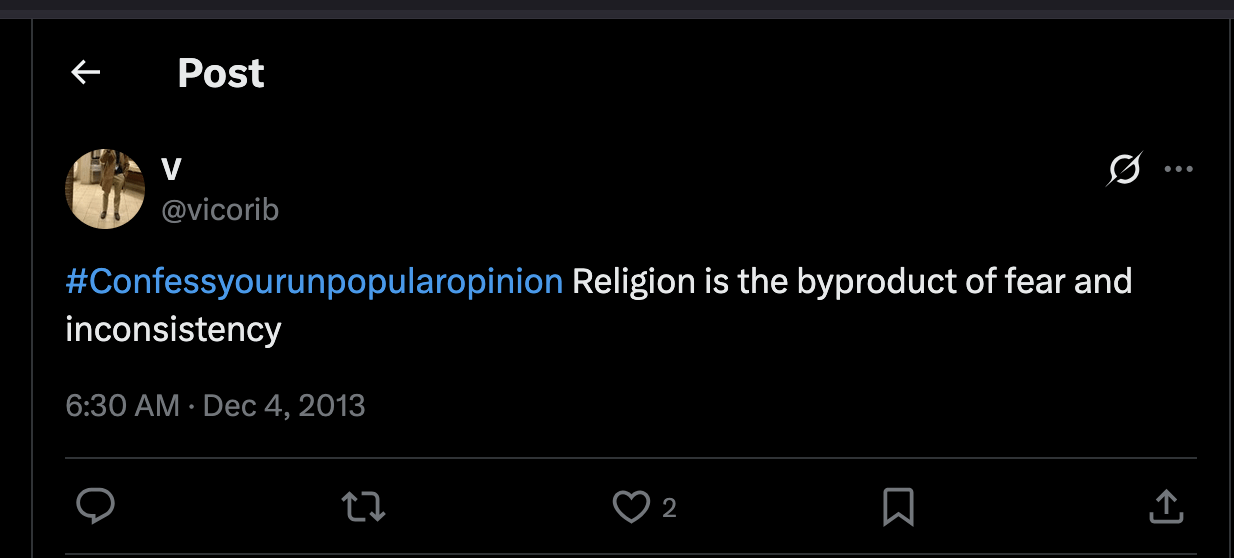
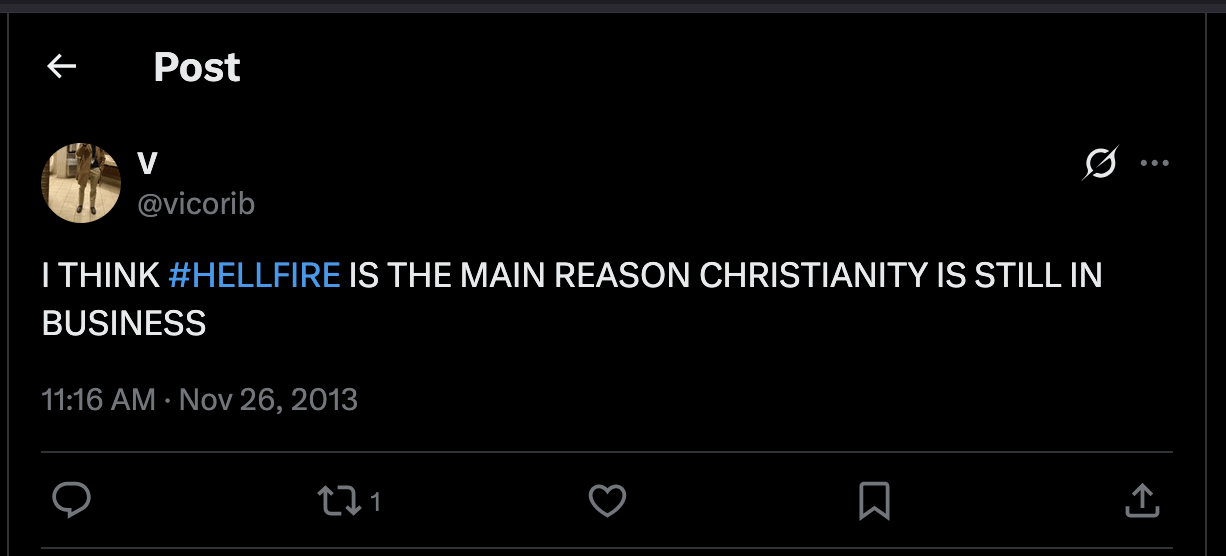
I can love the institution that raised me and still see the playbook. In fact you cannot see it clearly from outside. The critics who only ever stood across the street never had to reckon with the fact that the building works, that something real happens inside it, and that the engineering making it work is the same engineering making a funnel work in 2026.
The honest move, for those of us who build products, is to know what we are deploying when we deploy fear. The honest move, for those of us who still kneel, is to know what was deployed on us. Both honesties point at the same architecture.
The pew and the product. Same engine, different chassis.
V