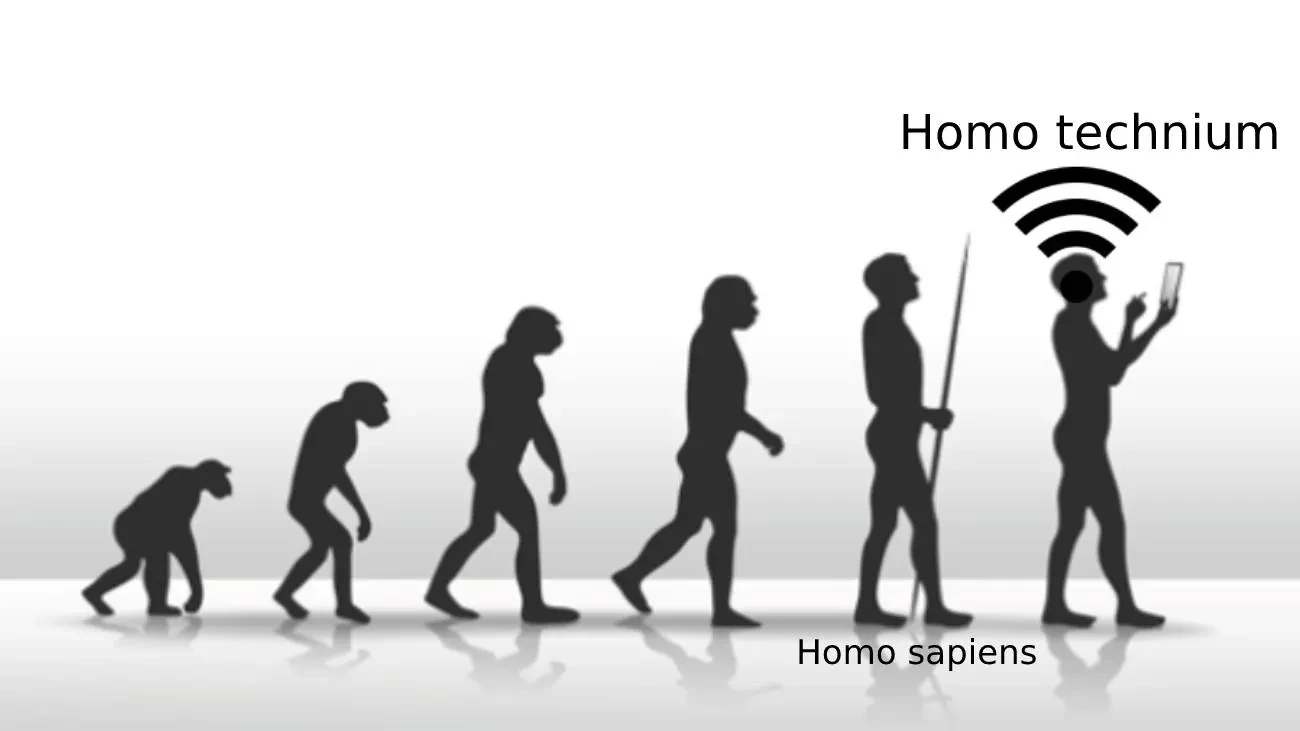
Look at the picture. Every figure in that line stands a little taller than the one behind it. The last one has a phone in his hand and a signal coming off his head.
That last one is you. That is me too.
A few decades ago, a phone lived on the wall and a computer filled a room. Today I carry one in my pocket that reaches almost everything humans have ever written down and connects me to anyone on the planet at any hour.
We already passed the point where technology and the person holding it can be pulled apart. We are becoming machines, one device at a time. I call this next stage of human evolution Homo technium: the fusion of humans and computers.
How We Got Here
The road to Homo technium has been long and gradual. It started in our pockets.
In 1983, Motorola put the DynaTAC 8000X on the market, the first commercially available handheld mobile phone. It weighed close to two pounds and sold for $3,995. That brick kicked off the march toward ubiquitous computing. Communication stopped being tied to a wall or a desk. It went wherever you went.
In 1989, Tim Berners-Lee wrote a proposal at CERN for sharing information between computers. That proposal became the World Wide Web. Today it sits under daily life like plumbing. It connected the planet and put the world's knowledge one search away.
Then we started putting the hardware inside the body. In 1998, cybernetics professor Kevin Warwick had an RFID chip implanted in his arm so the building he worked in would recognize him, open doors and switch on lights. In 2004, the FDA cleared the VeriChip, an implant beneath the skin that linked to a person's medical records. Since then, people have walked around with chips that unlock their front doors and pay for their coffee.
The Fusion Is Already in Your Head
Implants are the loud version of this story. The quiet version is happening inside our cognition, and most people never notice it.
We hand our memory to Google and Bing. We lean on artificial intelligence to solve problems and make decisions, which is the work we do every day at Kquika. We put our thoughts and ideas on social media and strap on virtual reality headsets to walk through worlds that do not physically exist.
Then in November 2022, OpenAI released ChatGPT, and millions of people started thinking out loud with a machine every day. In March 2023, GPT-4 raised the bar again. The speed of this is the point. The gap between a new tool and a new habit keeps shrinking.
I said it plainly on Twitter (screenshot attached below):

The thing is Homo technium. Computers and AI are the vehicles carrying us there.
What It Unlocks and What It Costs
When humans and computers fully merge, we push past the limits biology handed us. Stronger bodies and sharper minds become engineering problems with engineering answers. We will make kinds of art and music nobody alive can make today. We will study the universe in ways that used to live only in science fiction.
That road carries real danger, and I am not going to pretend otherwise.
The first danger is dependence. If the machine does all the thinking, the human muscle goes soft. We have to stay sharp enough to check the output and overrule it when it is wrong. I believe in keeping humans in the loop, and a human in the loop has to earn that seat.
The second danger is who gets the upgrade. If the benefits pool at the top, Homo technium turns into a new class system with better hardware. The fusion has to reach everyone, and humans have to keep their autonomy and agency the whole way through.
The Next Figure in the Line
Homo technium is a beautiful union of people and computers, and it is already underway. The line runs from a two-pound phone in 1983 to a web proposal in 1989 to chips under the skin and AI in every pocket. Every step points the same direction.
We get to decide how we arrive. Eyes open, with every human sharing the gains and holding the wheel.
Evolution never stopped. We are the next frame.