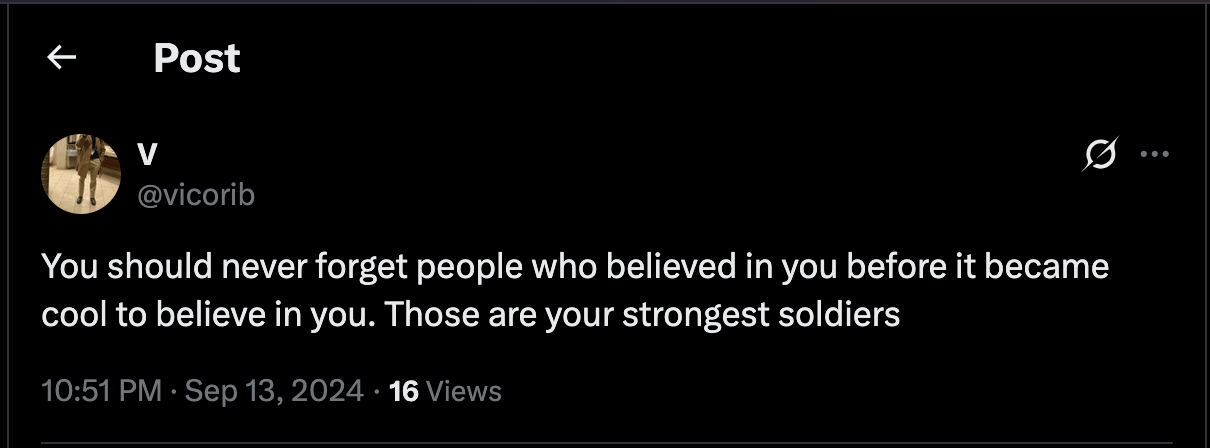
I have tweeted the same idea four times in seventeen months.
May 15, 2024, at 4:51 in the morning: always remember the people who believed in you when they had no reason to, back when it wasn’t cool. September 13: never forget the ones who believed before it became cool, because those are your strongest soldiers. October 10: paying them back for that belief is very important. Then last October, Palmer Luckey said the one thing money can’t buy is people who liked you before you had money, that he met his wife when he had less than $300 in his bank account, and I quoted him at midnight because I could not let it pass.
Seventy people saw the first one. Fifteen saw the second.
I kept posting it anyway, and that tells you something. When a founder repeats himself to an audience of fifteen, he is mostly talking to himself. Some ideas you say once. Others keep coming back until you sit down and deal with them properly.
So this is me dealing with it. And it starts with an essay I wrote almost four years ago.
The filter I wrote about in 2022
In December 2022 I published “Hiring people who give a fuck!” The whole internet was arguing about quiet quitting that fall, and I said the argument was pointed the wrong way. Most companies hire for a skill set and then act surprised when skill is all they get. I said I hire for something else: people who treat the company as an extension of themselves, who see the broken thing at 11 p.m. and fix it because leaving it broken would bother them personally.
I backed it with Gallup. Their State of the Global Workplace report found only 21% of employees worldwide engaged at work. Their meta-analysis showed top quartile teams on engagement posting 23% higher profitability and 41% fewer quality defects than bottom quartile teams. I quoted Jim Collins on getting the right people on the bus before you decide where to drive it.
I still stand behind every word of that post. Rereading it this week, I also noticed what it left out.
That essay was written from one side of the table. It explained how a founder finds people who care. It said almost nothing about what the founder owes them once he finds them. “Recognize the effort out loud” was about as far as I went. Four years, thousands of aircraft data records, and four tweets later, I think the second half of that deal deserves its own essay.
Where the filter actually came from
Here is what I understand now that I didn't fully understand in 2022. I never invented that filter. I learned it by being on the receiving end of it.
On October 20, 2021, around 6 PM, Ayomide and I decided on a FaceTime call to build a company that predicts when airplane parts fail before they fail. No aerospace degree between us. No uncle at Boeing. No revenue, no product, and no deck anybody serious would fund. At that moment there was nothing to believe in except two guys on a video call and an idea that sounded, to most reasonable listeners, a little insane.
Some people believed anyway.
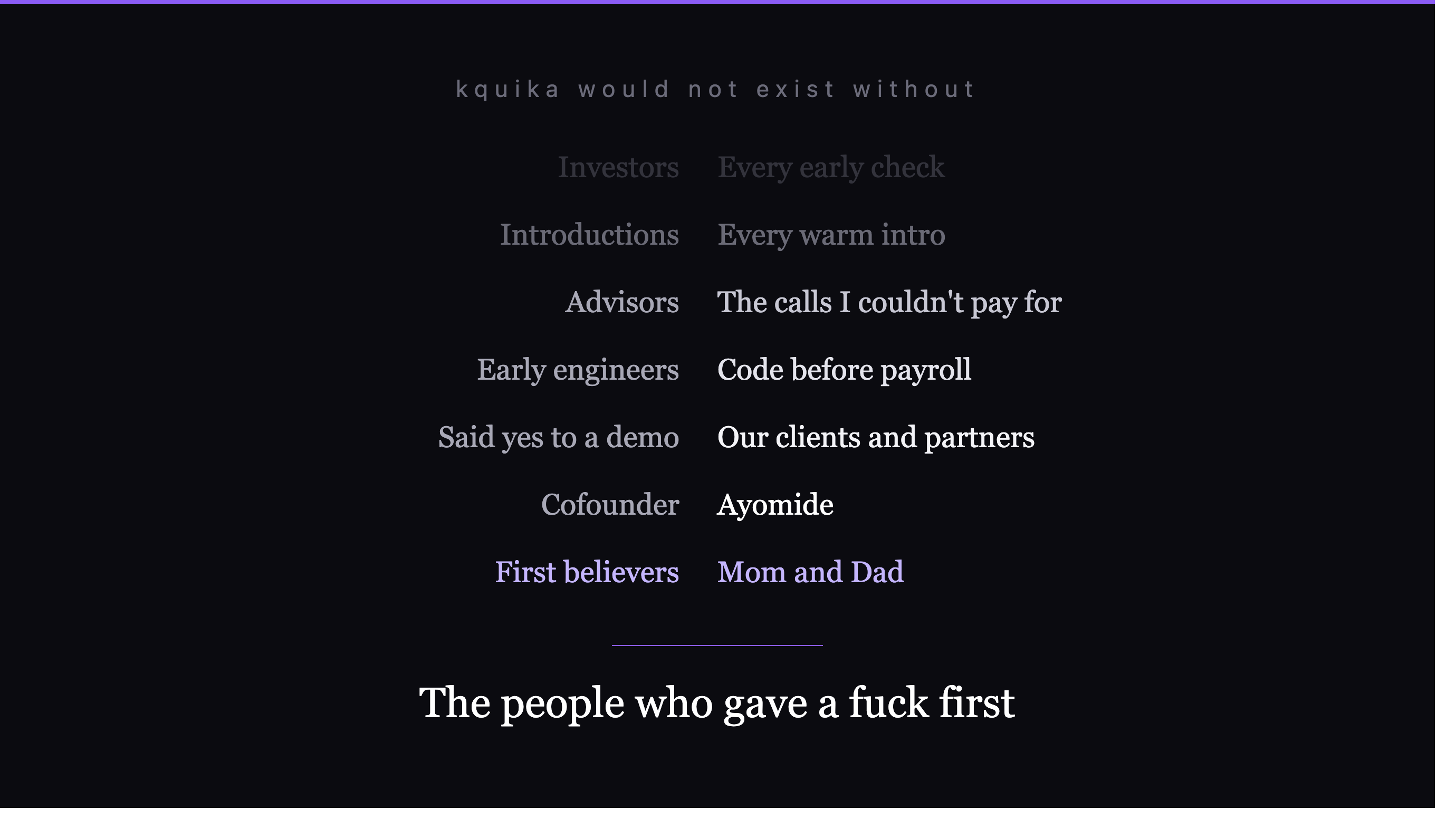
The first believers were my parents. Before there was a team, a customer, or even a name on an incorporation filing, they put their life savings behind their son and a company that existed mostly as an idea. They had every reason to keep that money safe, and they chose to put it on me instead. Every dollar Kquika has raised and made since then sits on top of that one.
Ayomide bet his career on a phone call. Early engineers wrote code for Kquika when the salary line in the budget was closer to a promise than a number. Advisors picked up my calls when I could not pay for their time, and nobody would have blamed them for letting it ring. Couple of folks that later became friends forwarded my name to someone at an airline, which meant putting their own reputation behind a company that had none. And the woman I married said yes to a man who, for most of the time she has known him, came home with a working demo and zero customers. She chose me long before there was anything to show for it.
Every one of those people passed the filter from my 2022 post before I ever wrote it down. They gave a fuck when there was no company yet to give a fuck about. That is the purest form of the trait I hire for, because nothing outside of them was rewarding it. There was no award in Munich and no airline logo on a slide. There was only the work and a guy asking them to trust him.
I wrote in 2022 that one person staying late on something hard changes what the rest of the team thinks is normal. I was describing the early believers without realizing it. They set the normal. Everyone who joined after inherited a culture those people built for free.
Let me give you the receipts
Once you know to look for this pattern, you see it underneath almost every company worth studying.
Start with aviation, because that is my lane. When the Wrights realized no engine manufacturer would build a motor to their specifications, they turned to Charlie Taylor, the mechanic they had hired for their cycle shop in 1901. Nearly a dozen automobile manufacturers had passed on the job, and Taylor finished it in six weeks without manuals, formal drawings, or proper tooling. The engine generated 12 horsepower and weighed only 152 pounds stripped. Charlie Taylor believed in two bicycle mechanics while the Smithsonian and the War Department were backing Samuel Langley. If you fly today, you fly in a world that a shop employee helped make possible.
Here is the part that I think about regularly. While the Wright brothers became household names, Taylor drifted into obscurity. When Orville died in 1948, he left Taylor an annuity, so the Wrights did not forget him. It was still not enough. A heart attack in 1945 left him unable to work, and when a reporter publicized how destitute he had become, the aviation industry raised money to move him into a private facility. Today the FAA’s Charles Taylor Master Mechanic Award carries his name, and his birthday, May 24, is celebrated as Aviation Maintenance Technician Day.
Read it again. The man who built the engine for the first powered flight needed strangers to take care of him at the end, and the honors came after he was gone. Orville’s annuity was a real gesture, and it arrived late and fell short. That story bothers me more than any rejection I have ever received, and it is a big part of why I keep tweeting about repayment.
Jump to 2008. Brian Chesky later published a post called 7 Rejections. On June 26, 2008, Michael Seibel introduced the Airbnb founders to seven prominent Silicon Valley investors while they were trying to raise $150,000 at a $1.5 million valuation, which would have bought an investor 10% of the company. Five rejected them and the other two never replied. The early yes came from Y Combinator, starting with a $20,000 seed check. The people who said yes early did not have better spreadsheets than the ones who said no. They had a read on the founders that the market had not caught up to yet.
Then Nvidia. Jensen Huang flew to Japan to admit in person that a chip Nvidia was building with Sega had failed, then asked Sega to turn a contract payment into an equity investment, telling Shoichiro Irimajiri the money would most likely be lost. Irimajiri backed him and persuaded Sega’s board, and the $5 million bought Nvidia roughly six more months, which it used to build the RIVA 128.
Now watch what Jensen did with that belief thirty years later. This past July, at an event in Tokyo’s Akihabara district attended by Irimajiri, Huang said that without Sega’s financial aid “Nvidia would be out of business today.” The reunion marked nearly three decades since the investment, and the two companies used the same meeting to announce a new partnership. The CEO of the most valuable company on earth got on a plane to say thank you to the man who believed when Nvidia had nothing to show. That is what repayment looks like at scale. He brought new business back to the people who took the first risk.
And then Palmer Luckey, who has more money than almost anyone reading this, saying the one asset he could never purchase was a wife who chose him at $300. Rich people do not usually volunteer that their scarcest resource is early belief. When one does, pay attention.
Why early belief is worth more than late belief
I run a prediction company, so let me put this in the language I use every day.
Belief in a founder is a forecast. A person who believes in you at year zero is making a prediction with almost no data. No track record, no revenue, no third party validation. The error bars are enormous, and they are putting their own time, money, or reputation inside those error bars.
A person who believes in you after the award, after the contracts, after the press, is reading a result that already happened. Nothing wrong with that. I welcome every customer, investor, and hire who shows up now, and Kquika needs them. Their belief simply carries less risk, so it carries a different weight on the ledger.
In maintenance, the sensor that catches an anomaly early is worth more than the one that confirms the failure after the engine shuts down. Early signal is the whole game. The people who believed in me early were early signal in human form. They saw a failure-prediction company inside two tired graduate students on a FaceTime call. That deserves a different level of respect, and in my opinion, a different level of repayment.
What paying them back looks like
“Repay them and take care of them forever” fits in a tweet. Doing it is harder. Here is what it means at Kquika, and what I think it should mean for any founder lucky enough to have early believers.
Tell them the truth first. When something big happens at the company, good or bad, the people who carried us when it was ugly hear it from me before they read it anywhere else. A contract win, a hard quarter, a strategic shift. Being early earned them a seat close to the information.
Put real ownership behind the gratitude. Thank you notes are nice. Equity, profit sharing, and first claim on the roles they want are better. If someone took a risk on you when the risk was real, structure the upside so they actually participate in what they helped create.
Pay them while they can still use it. Orville’s annuity for Charlie Taylor came through a will. Jensen’s thank you to Irimajiri came while both men could stand on the same stage. Do the Jensen version.
Name them in public. Every win Kquika has ever had carries our company’s name on the announcement, and every one of them was built by people whose names never make the headline. The award, the new contracts, the models validated on defense lab data, the first deployment on a new continent. I make a point of saying those names out loud every time, on stage, on the blog, in the room with customers. Recognition costs nothing and most founders still hoard it.
Invest in their growth even when it takes them somewhere else. Some early believers will outgrow Kquika, and that is a win. If I helped someone become the kind of operator another company wants to recruit, that is repayment working exactly as intended. My job is to make sure their belief in me paid off for them, wherever they end up.
Show up for their stuff. Their weddings, their launches, their funerals, their kid’s first day. Belief is a relationship, and relationships get maintained in the moments that have nothing to do with the business.
The honest caveat
My 2022 essay ended with a caveat, so this one will too.
Loyalty to early believers can turn into a liability if you handle it badly. Sometimes the person who believed first is no longer the right person for the seat they are in. The company has grown, the role has changed, and the job requires something they do not want to do or have not yet learned. Founders who keep early believers in the wrong roles out of guilt end up hurting the company and the person at the same time.
When that happens, I owe them two things. I owe them the truth early, before the situation becomes a problem everyone else can see. And I owe them a generous landing, which includes my name on whatever comes next. Taking care of someone forever has nothing to do with keeping them in the same chair forever. It means they never doubt whether you have their back.
There is a second risk too. Founders who talk about loyalty constantly can drift into treating everyone who joined later as mercenaries. That is a mistake. Some of the best people at Kquika arrived after the awards, and they give a fuck every bit as much as the people who were there on day one. The 2022 filter still applies to every hire. Early belief deserves a special kind of gratitude, and that gratitude should never harden into a caste system.
Back to the filter
So here is the updated version of the post I wrote in December 2022.
Hire people who give a fuck. That advice holds. Gallup’s numbers still back it, Collins still backs it, and everything I have lived through at Kquika backs it.
Then find the people who gave a fuck about you before there was a company to care about, before there was a paycheck, before it was cool to say your name in a meeting. Write their names down. Repay them with truth, ownership, credit, and presence, and keep doing it long after the company stops needing their help.
The Wrights got the history books. Charlie Taylor got an annuity in a will and a collection at the end. Irimajiri got a plane ticket’s worth of gratitude, a stage in Akihabara, and a new partnership thirty years later. I know which ending I want to write.
To everyone who believed in us before there was anything to believe in, and who still believes today, who backed us with capital, with code, with introductions, with late night calls, and with their own reputations when ours didn’t exist yet: I see you. I have not forgotten. I am still paying, and I will keep paying all the way to the IPO bell and long after it rings.
V